


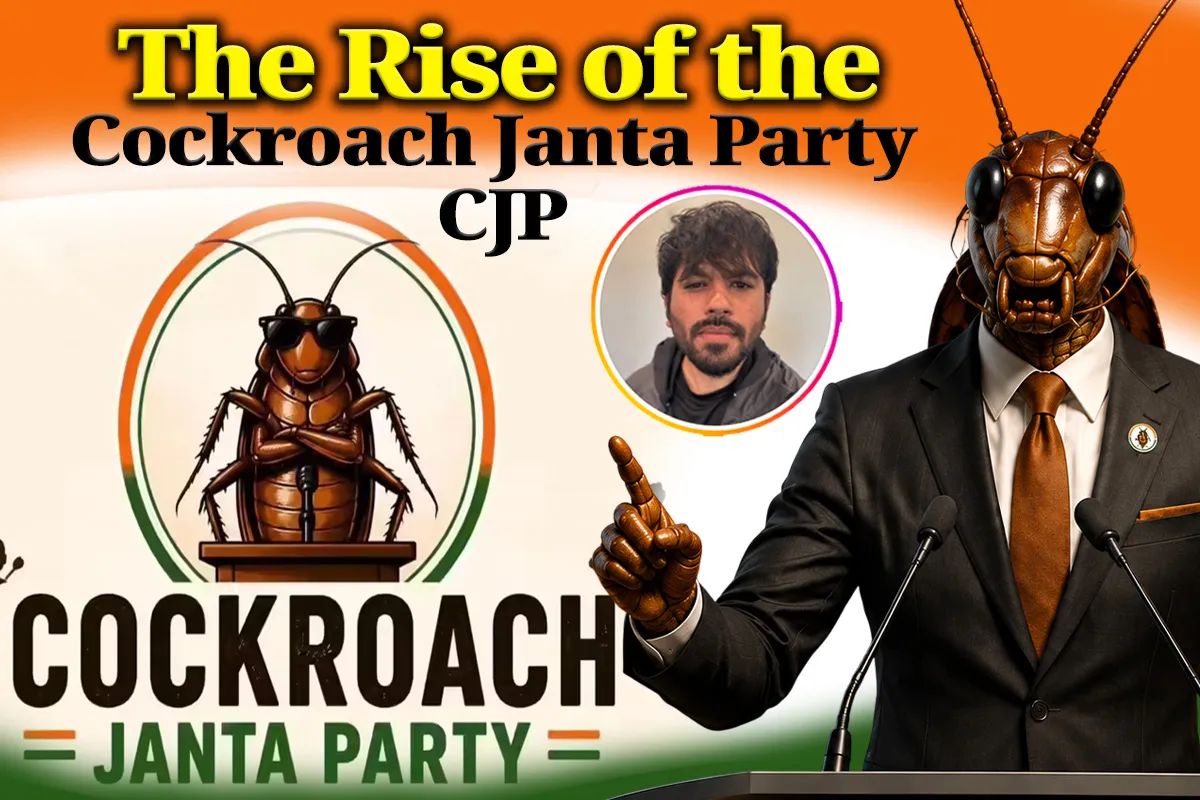
An accidental political movement is taking the Indian internet by storm. Calling itself the Cockroach Janta Party (CJP), this satirical political outfit has transformed from a Twitter joke into a massive participatory protest, claiming over 100,000 registered members and millions of social media followers within days of its launch.
Billed under the mock-motto "Secular, Socialist, Democratic, and Lazy," the CJP has evolved into a digital megaphone for India's youth, channeling deep-seated frustrations regarding unemployment, paper leaks, and institutional disconnect.
The Origin Story: A Courtroom Controversy
The meteoric rise of the Cockroach Janta Party stems directly from a Supreme Court hearing on May 15, 2026. While presiding over a case involving fake professional credentials, Chief Justice of India (CJI) Surya Kant remarked:
"There are youngsters like cockroaches, who don't get any employment or have any place in profession. Some of them become media, some of them become social media, RTI activists and other activists and they start attacking everyone."
Though the CJI quickly issued a clarification the next day—stressing his comments were misquoted and aimed strictly at individuals using fake degrees rather than the nation's unemployed youth—the "cockroach" label had already sparked severe online backlash.
Seizing the moment on May 16, Abhijeet Dipke, a 30-year-old digital media strategist and former social media worker for the Aam Aadmi Party (AAP), launched a Google Form on X (formerly Twitter) inviting fellow "cockroaches" to unite. The joke instantly struck a chord. Rather than rejecting the insult, India’s youth weaponized it, adopting the cockroach as a symbol of stubborn resilience—creatures that survive against all odds in a harsh system.
Inside the Mock Manifesto and Membership Criteria
Operating from its central portal (cockroachjantaparty.org), the party jokes that its headquarters is located "wherever the Wi-Fi works." To join the "swarm," applicants must jokingly fit a hyper-specific Gen-Z checklist:
-
Employment Status: Unemployed by force, choice, or principle.
-
Screen Time: Chronically online for at least 11 hours a day.
-
Skillset: Professionally talented at venting and ranting online.
-
Productivity: Lazy enough to avoid toxic motivational reels.
Behind the humor, however, the CJP features a surprisingly sharp, anti-establishment 5-point manifesto targeting core structural issues in Indian governance:
-
Judicial Independence: A complete ban on post-retirement Rajya Sabha seats or government rewards for Chief Justices.
-
Anti-Defection Laws: A strict 20-year election ban on any MP or MLA who switches political parties.
-
Gender Equality: Mandatory 50% reservation for women in parliamentary and cabinet positions without expanding the House's size.
-
Transparency: Total accountability under the RTI Act and a complete refusal of anonymous political donations.
-
Student Reform: Scrap rechecking fees charged by the CBSE (calling it institutional corruption) and dynamic accountability for structural exam frauds like the NEET controversy.
The party has also chosen the smartphone as its official voting symbol, stating that "the revolution starts from your screens."
Mainstream Traction and Real-World Impact
What started on meme pages has rapidly filtered into mainstream politics. High-profile opposition politicians, including Trinamool Congress (TMC) MPs Mahua Moitra and Kirti Azad, publicly reached out to join the digital platform on X.
Furthermore, the movement has broken past the digital barrier. Groups of young volunteers have been spotted organizing peaceful civic drives near polluted waterways and garbage dumps, holding signs reading "I Am A Cockroach." The symbolism is deliberate: if the establishment views the youth as a nuisance, they will respond with public service and radical civic engagement.
As the movement plans a virtual Gen-Z convention, founder Abhijeet Dipke has recently alleged hacking attempts on their social media pages, claiming that established political figures are "scared of youngsters making jokes." While the CJP is not an officially registered party under the Election Commission of India, its historic, rapid growth proves that participatory satire has become a powerful new currency in modern Indian democracy.