

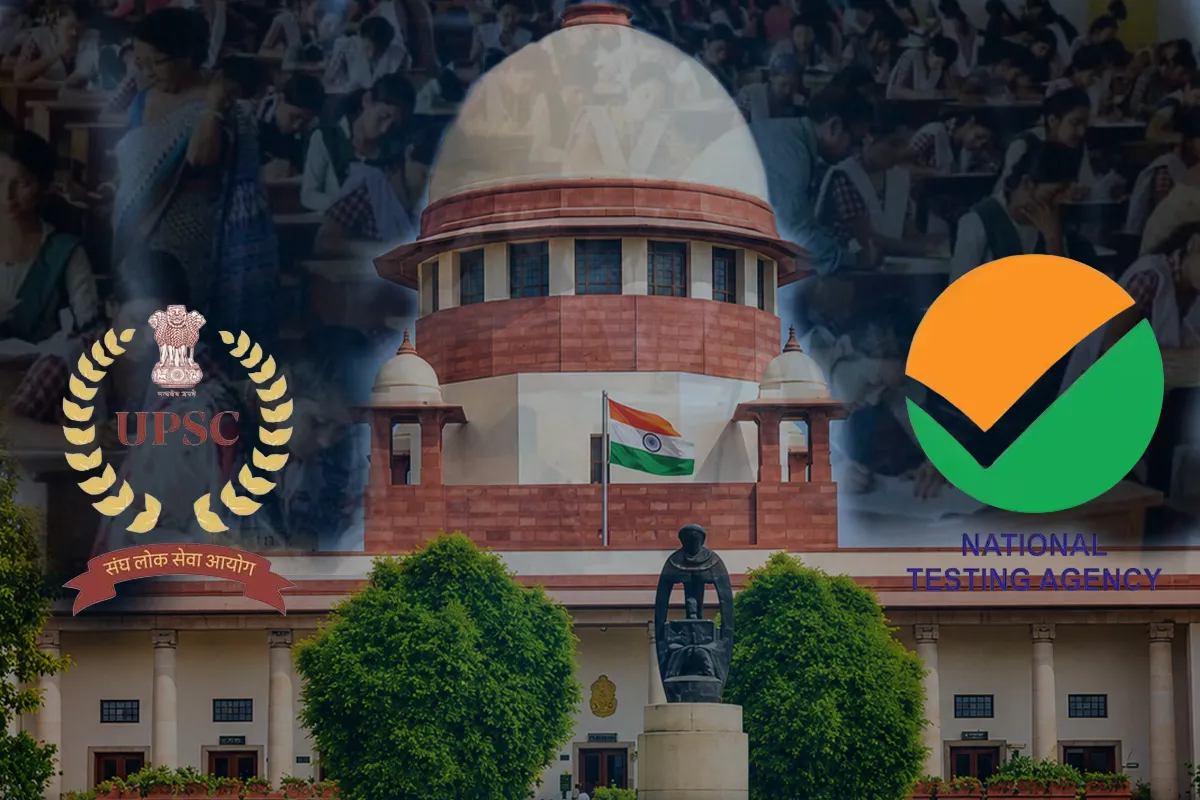
NEW DELHI — In a stern reprimand regarding national examination security, the Supreme Court of India sharply criticized the National Testing Agency (NTA). While hearing petitions concerning the cancellations and paper leaks plaguing the medical entrance exam (NEET-UG), a vacation bench of Justice P.S. Narasimha and Justice Alok Aradhe pointed out that premier institutions like the Union Public Service Commission (UPSC) conduct massive national-level exams flawlessly. The apex court noted that the NTA needs to learn from the UPSC’s airtight systems to avoid compromising the future of millions of students.
Supreme Court Hearing
-
UPSC’s Clean Record as a Benchmark: The top court highlighted that the UPSC, which recruits the country’s top bureaucrats and civil servants, has never faced a paper leak crisis. "UPSC has never been in such a situation. You need to learn from them," the bench observed.
-
Failure of Existing Safeguards: The court sharply questioned how massive breaches continue to slip through despite multiple monitoring systems and high-level reform committees.
-
The Trauma on Young Minds: The bench voiced strong empathy for the student community, stating that recurring examination failures are "actually very traumatic" for both the candidates and their families.
"Fix Individual Accountability to End Paper Leaks"
The Supreme Court emphasized that institutional paper leaks cannot be stopped simply by rolling out structural guidelines or passing the buck to vague departments. The real solution lies in pinpointing exactly who is responsible for each node of the examination chain.
"The real problem won't stop till actual accountability arises. It will be effective when we know which individual shoulders the responsibility. Unless you identify the specific duty-bearers, it will be difficult." — Justice P.S. Narasimha
The bench also called out the "ad-hoc nature" of the NTA's functioning. It observed that many institutions across the country rely on temporary setups rather than building robust systems. The court stressed the critical need for an "institutional memory of continuity"—meaning the NTA must employ permanent, specialized personnel who possess the physical and intellectual capacity to execute large-scale, high-stakes exams flawlessly.
Status of Reforms and What Happens Next
The court interacted directly with Dr. K. Radhakrishnan, former ISRO chief and head of the High-Level Monitoring Committee on exam reforms. Dr. Radhakrishnan informed the bench that the committee had recommended 101 total reforms to secure the exam lifecycle. Out of these, 60 short-term measures were planned for immediate implementation. He admitted that the primary vulnerability was directly tied to the question paper-setting process.
The Solicitor General, representing the Centre and the NTA, assured the court that rigorous investigations are ongoing and revised security mechanisms are being actively deployed ahead of upcoming re-examinations. The Supreme Court has directed the Union of India to submit a formal affidavit detailing exactly how they plan to eliminate the ad-hoc model and restructure the NTA into a more capable, flawless institution.