

KUWAIT CITY — In a major escalation that has sent shockwaves through the international community and severely strained regional security, Kuwait International Airport was struck by a barrage of Iranian drones and ballistic missiles. The attack, which targeting Terminal 1 (T1) of the civilian airport, has resulted in the tragic death of an Indian national and left at least 63 others wounded, multiple individuals sustaining life-threatening injuries.
The sudden assault disrupted what had been a fragile ceasefire in the ongoing wider conflict involving the United States, Israel, and Iran, instantly shutting down commercial aviation operations in the Gulf nation.
Direct Hit on Passenger Terminal Triggers Chaos
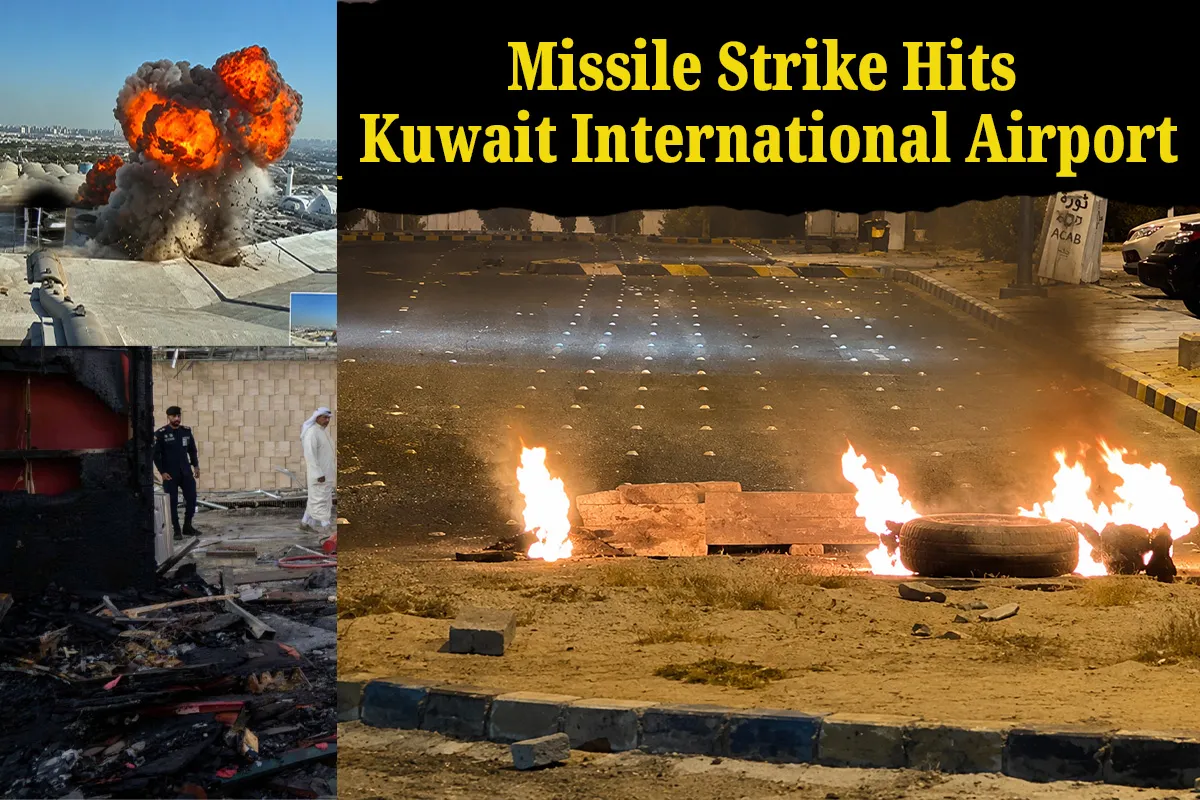
According to reports from the Kuwaiti Ministry of Defense, the attack commenced in the early morning hours when a wave of hostile aerial projectiles entered Kuwaiti airspace. While Kuwaiti air defense systems managed to intercept a large portion of the incoming threat—destroying 13 ballistic missiles and 17 one-way attack drones—several projectiles evaded defenses and slammed directly into the airport's main passenger terminal building.
CCTV and mobile footage released by the Kuwait Directorate General of Civil Aviation (DGCA) captured the terrifying moments of the strike. The videos show a massive fireball tearing through sections of Terminal 1, leading to structural collapses, shattering glass, and forcing hundreds of morning travelers and airport workers to run for cover amidst thick billows of suffocating black smoke.
Critical Casualties and Severe Medical Emergency
The humanitarian toll of the strike has been devastating. The Kuwaiti Health Ministry deployed over 25 ambulances to the tarmac and terminal building immediately following the blasts.
Health Ministry spokesperson Dr. Abdullah al-Sanad confirmed that 63 injured individuals were rushed to various regional hospitals. The nature of the injuries highlights the sheer brutality of the impact, with medical officials reporting:
-
Severe blast injuries and internal trauma
-
Complex head wounds and cerebral hemorrhages
-
Shrapnel-induced limb amputations
-
Heavy smoke inhalation among passengers trapped in the terminal
Tragically, one fatality was recorded at the scene. The Indian Embassy in Kuwait later confirmed that the sole deceased individual was an Indian national working or traveling through the facility.
Diplomatic Fallout: Kuwait Retaliates by Expelling Diplomats
The attack has pushed diplomatic relations between Kuwait and Tehran to a breaking point. Kuwait's Deputy Foreign Minister, Hamad Suleiman Al-Mashaan, summoned Iran’s chargé d'affaires to issue a blistering formal protest. Denying Iranian allegations that Kuwaiti territory was used by the U.S. military to strike Iranian assets, the Kuwaiti government made it clear that it will "neither accept nor tolerate" such blatant violations of its sovereignty.
As an immediate punitive measure, Kuwait declared two Iranian diplomats persona non grata, giving them a 24-hour ultimatum to clear out of the country, while simultaneously ordering a significant reduction in the overall staff size of the Iranian Embassy in Kuwait City.
Geopolitical Context: A Fragile Ceasefire Shattered
The strikes on Kuwait coincided with a similar aerial bombardment aimed at Bahrain, which houses the U.S. Navy's Fifth Fleet. Iran’s Islamic Revolutionary Guard Corps (IRGC) initially issued statements claiming they were retaliating for a prior U.S. strike on an Iranian oil tanker near the strategic Strait of Hormuz.
While Iranian state media attempted to deflect blame by asserting that a malfunctioning U.S. Patriot interceptor missile was responsible for the airport damage, U.S. Central Command (CENTCOM) quickly dismissed the claim as entirely fabricated. U.S. military officials termed the bombardment a "deliberate, calculated, and unjustified attack" on non-combatant, civilian infrastructure.
Indian Embassy Mobilizes Emergency Assistance
In New Delhi, India's Ministry of External Affairs strongly condemned the strike and called for an immediate cessation of violence targeting innocent civilians.
India's Ambassador to Kuwait, Paramita Tripathi, visited the Central Mortuary to fast-track paperwork for the repatriation of the deceased Indian citizen's mortal remains. Ambassador Tripathi also toured local hospitals to meet with the injured Indian nationals, assuring them that the embassy is closely coordinating with hospital administrations and their families back home to guarantee maximum medical and logistical support.


.png)