


India's democratic journey is hitting a historic milestone. Prime Minister Narendra Modi is on the verge of surpassing Jawaharlal Nehru's record of 4,398 continuous days as the head of an elected government. Beyond the political longevity of these two towering leaders, the milestone brings to the forefront a staggering reality: the sheer scale of transformation India has undergone.
From a newly independent country of 34 crore (340 million) citizens under Nehru, India has transformed into a global superpower housing over 1.4 billion (140+ crore) people under Modi. This is the story of how India changed its economic grammar, its political landscape, and its very outlook toward its most massive asset—its population.
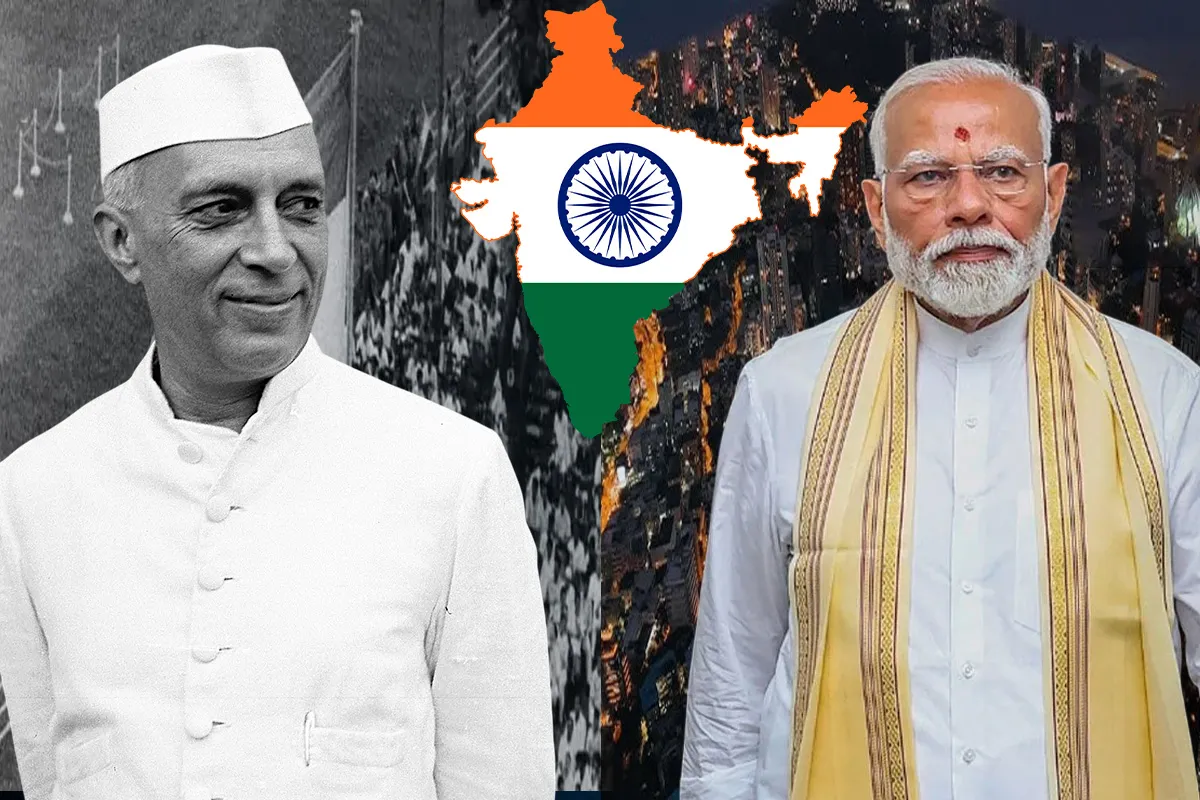
The Demographic Shift: From "34 Crore Problems" to "140 Crore Solutions"
The philosophical difference between India’s first Prime Minister and its current one is most visible in how they viewed the country's population.
-
The Nehruvian Outlook: Facing severe food shortages, a fractured post-partition geography, and systemic poverty, Jawaharlal Nehru famously remarked that his biggest challenge was the "345 million problems" represented by India's population. In the early decades, a massive population was treated by the state as an economic burden and a strain on scarce resources.
-
The Modi Outlook: In stark contrast, the current administration views India’s demographic footprint as its ultimate strength. Prime Minister Modi has consistently framed India's 1.4 billion people not as mouths to feed, but as hands to build, branding them as a powerhouse of talent, innovation, and global consumer demand.
Economic Paradigms: Socialism vs. Digital Capitalism
The economic architecture of the two eras could not be more distinct. Nehru inherited a colonial economy and leaned heavily on a socialist-inspired, state-controlled model. Modi, on the other hand, operates in a hyper-digitized, market-driven global economy.
The Structural Shift: While Nehru built the foundational infrastructure of India—like the IITs, space programs, and massive dams—the economy grew at a restrictive pace. Today, India is the world's fastest-growing major economy, driven by massive public digital infrastructure (like UPI) and a soaring manufacturing push.
The Political Grammar: Secular Consensus vs. Cultural Nationalism
The transition from 34 crore to 1.4 billion people has completely rewritten India's social and political landscape.
Nehru established the "Secular Consensus", a framework aimed at national integration by keeping religion separated from state identity to stabilize a newly fractured nation.
Decades later, the political gravity has shifted toward Cultural Nationalism, blended with welfare delivery. The current political climate integrates India's civilizational identity into statecraft—marked by monumental milestones like the resolution of the Ram Temple and the integration of Jammu and Kashmir via the revocation of Article 370—while simultaneously operating the world's largest digital welfare system.
Summary: A Nation Reimagined
The transition from Nehru’s India to Modi’s India is not just a story of exploding census data. It represents a fundamental shift in self-belief. India has evolved from an inward-looking, protective republic trying to survive its own population into an assertive, tech-driven global superpower that leverages its 1.4 billion citizens to lead the global order.

3.png)
7.png)