


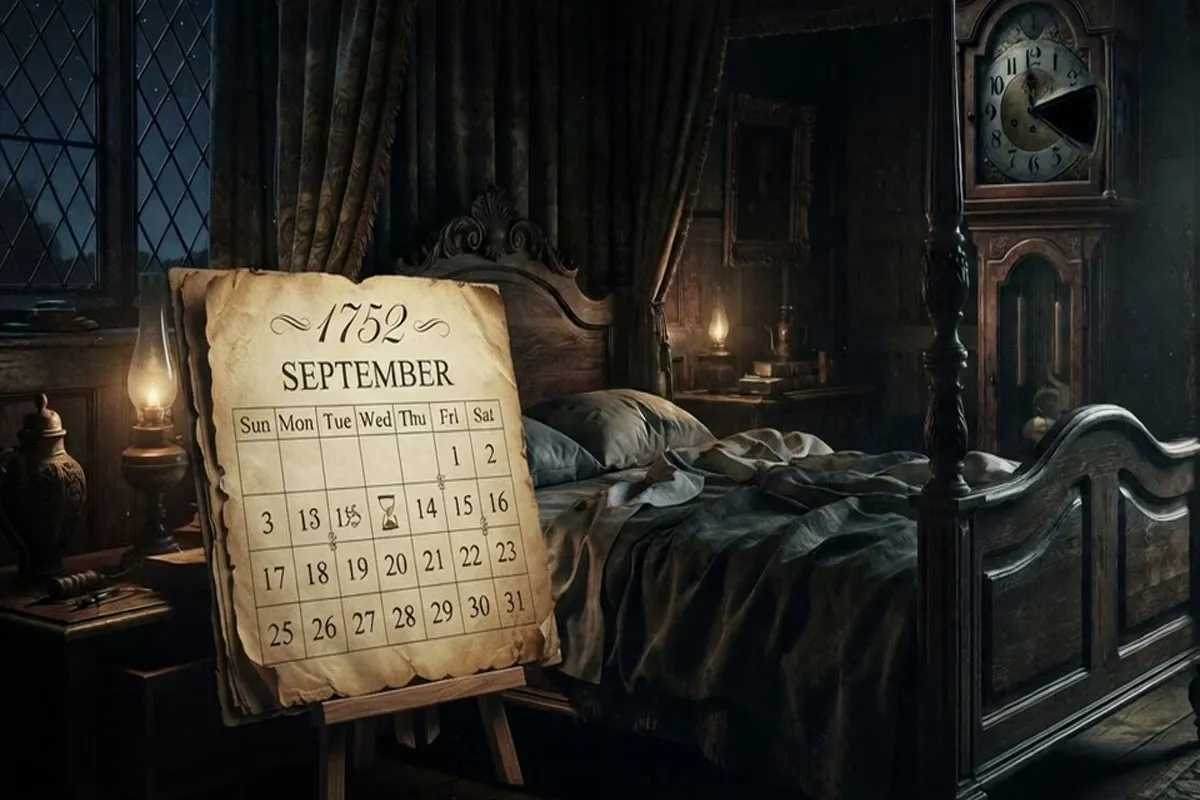
On the evening of Wednesday, September 2, 1752, millions of people across Great Britain and its colonies—including the American colonies—went to bed as usual. When they woke up the following morning, the date wasn't September 3. It was Thursday, September 14, 1752. Overnight, 11 calendar days ceased to exist.
This abrupt leap was not due to a temporal anomaly, magic, or mass slumber, but rather a long-overdue political and scientific realignment: Britain was finally adopting the Gregorian calendar.
The Flaw in Caesar’s Math
For over 1,800 years, the British Empire had relied on the Julian calendar, established by Julius Caesar in 46 BC. The Julian system assumed a solar year lasted exactly 365.25 days, adding a leap year every four years.
However, the Earth actually takes roughly 365 days, 5 hours, 48 minutes, and 45 seconds to orbit the Sun. That tiny 11-minute annual overestimation stacked up over centuries, drifting by approximately one full day every 128 years. By the mid-18th century, the British calendar was out of sync with natural solar seasons by nearly a fortnight, causing agricultural and astronomical confusion.
Protestant Pride vs. Astronomical Reality
In 1582, Pope Gregory XIII introduced the corrected Gregorian calendar to fix the issue and prevent movable religious holidays like Easter from drifting out of spring. Catholic nations in Europe—such as France, Spain, and Italy—immediately adopted the change.
Britain, staunchly Protestant following the English Reformation, refused to follow a papal decree. For nearly two centuries, Britain remained on "Old Style" time, causing diplomatic headaches and trade friction because British dates differed from those in continental Europe by up to 11 days.
The Calendar Act of 1750
Parliament finally resolved the mismatch by passing the Calendar (New Style) Act 1750. The legislation outlined two major changes:
-
Shifting New Year’s Day: The official start of the year moved from March 25 (Lady Day) to January 1.
-
Dropping 11 Days: September 3 through September 13, 1752, were deleted entirely to realign the calendar with Europe.
Julian Calendar: Sep 1 → Sep 2 → [11 Days Skipped] → Sep 14 (Gregorian) Day of the Week: Tue → Wed → ───────────────── → Thu Myth vs. Reality: Did People Really Riot?
A popular historical legend claims that angry mobs took to the streets of London shouting, "Give us back our eleven days!" Believers supposedly feared the government was cutting 11 days off their lifespans or cheating them out of wages.
Modern historians largely consider these "calendar riots" an urban legend. The myth primarily stems from a misinterpretation of William Hogarth’s 1755 satirical painting, An Election Entertainment, which depicts a campaign banner bearing the slogan.
While there was minor confusion regarding lease agreements, interest payments, and birthday celebrations, the legal act made provisions ensuring workers were not shortchanged on rent or wages due to the skipped dates.
A Lasting Legacy: The British Tax Year
The 11-day jump created one lingering quirk still present today: the UK financial tax year.
Under the old calendar, the financial year began on Lady Day, March 25. To ensure the Treasury did not lose 11 days of tax revenue in 1753, the start of the tax year was moved forward 11 days to April 5. Another day was added in 1800 when the Gregorian calendar skipped a leap year that the Julian calendar would have kept, shifting the date to April 6—where the UK tax year remains to this day.
2.png)
2.png)
1.png)

1.png)
.png)