


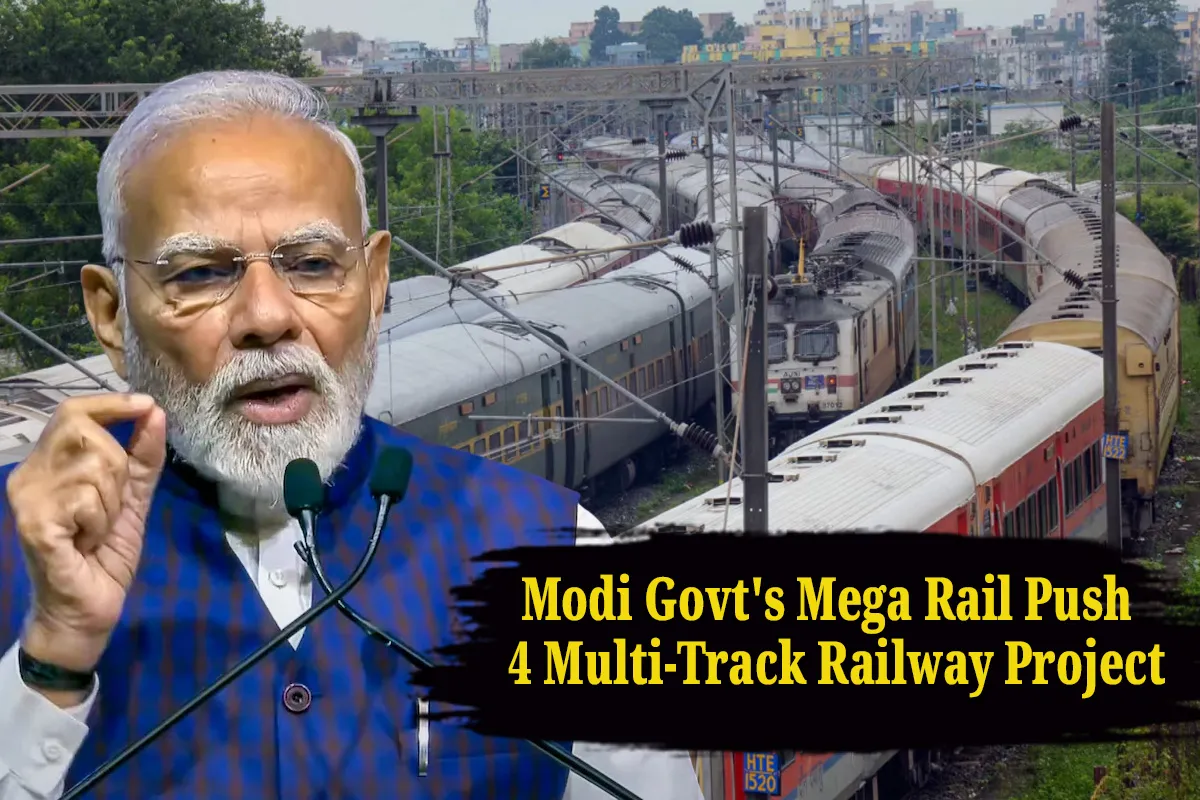
The Cabinet Committee on Economic Affairs (CCEA), chaired by Prime Minister Narendra Modi, has greenlit an ambitious infrastructure plan: four major multi-tracking railway projects worth approximately ₹11,169 crore. Designed to expand the existing network by 574 kilometers, this initiative targets high-congestion corridors spanning 13 crucial districts across six states: Maharashtra, Madhya Pradesh, West Bengal, Bihar, Odisha, and Jharkhand.
By laying down critical 3rd and 4th lines, this strategic expansion is set to fundamentally reshape regional economies, eliminate severe cargo bottlenecks, and accelerate India’s broader logistical capabilities.
The 4 High-Impact Railway Corridors
The central plan addresses congested routes heavily utilized for both passenger transit and industrial freight. The four sanctioned multi-tracking projects include:
-
Itarsi – Nagpur 4th Line: To clear the massive structural bottleneck in central India's primary North-South corridor.
-
Aurangabad (Chhatrapati Sambhajinagar) – Parbhani Doubling: To drastically increase frequency and reliable connectivity within Maharashtra's Marathwada region.
-
Aluabari Road – New Jalpaiguri 3rd and 4th Line: A vital expansion strengthening the gateway into West Bengal, Bihar, and the North-Eastern states.
-
Dangoaposi – Jaroli 3rd and 4th Line: Aimed primarily at easing the mineral-heavy transport routes cutting across Odisha and Jharkhand.
Changing the Destiny of 6 States: The Core Benefits
1. Slashing Logistics Costs & Boosting Freight Traffic
One of the primary goals of the plan is to drop India's supply-chain logistics costs down to single digits. These specific tracks serve as essential passages for transferring commodities like coal, cement, clinker, fly ash, agricultural products, and petroleum. The expansion is projected to facilitate an impressive additional freight traffic of 95.91 MTPA (Million Tonnes Per Annum).
2. Rural Transformation & Inclusive Development
The multi-tracking upgrades will provide direct, seamless rail access to 2,309 villages, directly integrating a combined population of over 43.60 lakh people into the mainline economy. This helps long-isolated rural pockets access nearby urban job markets, standard healthcare, and education easily.
3. Employment Generation & ‘Atmanirbhar Bharat’
Aligned with the Prime Minister's vision of a self-reliant India, the execution phase of these projects is slated to generate 229 lakh human-days of direct employment, providing massive localized economic relief and self-employment avenues during the construction phase.
4. Meeting India's Green Climate Targets
By shifting cargo volume from carbon-heavy road transit over to energy-efficient rail lines, the plan brings enormous environmental payoffs. It is expected to:
-
Cut national oil imports by 16 crore liters.
-
Mitigate carbon dioxide ($CO_2$) emissions by 515 crore kilograms—an impact equivalent to planting 20 crore trees.
Powered by PM Gati Shakti
The entire blueprint is designed under the PM Gati Shakti National Master Plan. Instead of the traditional, slow-moving bureaucratic route, this framework utilizes integrated, digital spatial planning to coordinate seamlessly across state governments and union ministries. The resulting speed ensures minimal execution delays, optimized multi-modal hubs, and an efficient infrastructure network capable of matching India's target economic growth.

3.png)
7.png)